
Today both the Deutsche Welle and the UK’s Guardian had interesting articles regarding an experiment conducted by test researcher Claudia Fritz of the University of Paris. This experiment was completed in 2010 at an international violin competition in Indianapolis, IN. She dimmed the lights, had 21 professional violinists put on welding glasses and then gave them each six different violins; three newly made violins, two originals made by Antonio Stradivarius circa 1700, and 1 violin made by Guarneri del Gesu circa 1740. The professional musicians were then asked to rank the playability of each of the violins. The results were surprising. In all cases, the musicians preferred the playability of the new violins to the old and respected relics. One of the Stradivarius violins actually came in dead last.
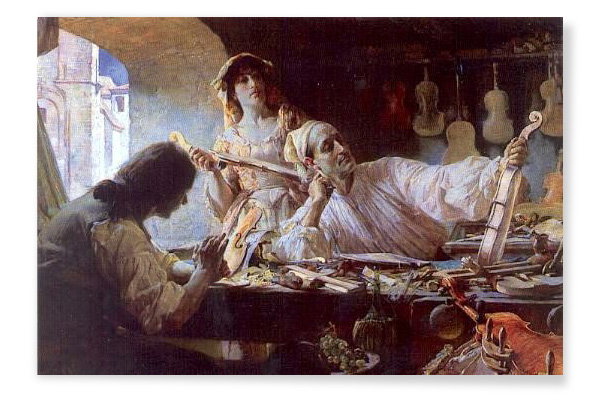 Antonio Stradivari, by Edgar Bundy, 1893
Reading about this wonderful experiment sent me on a philosopher’s trip about the amazing power of brands and how we perceive the value of a product. If you turned up the lights, removed the welders goggles and gave these same violinists a Stradivarius followed by a new violin, I’m guessing the violin with the 10 million dollar price tag will win the perception of what a master violin should sound like. This suspicion was somewhat confirmed in the Guardian’s version of the article when they interviewed Kai-Thomas Roth of the British Violin Making Association. Roth reported that there have been double blind tests where people and experimenters were blindfolded and asked to tell the difference between a new violin and a priceless antique. Here again, none could distinguish with any certainty which was the new and which one was the old. Furthermore, Roth summarizes in the article, “There’s some myth-making that helps old instruments. If you give someone a Stradivari and it doesn’t work for them, they’ll blame themselves and work hard at it until it works. Give them a modern violin, and they’ll dismiss the instrument straight away if it doesn’t work for them. That’s the psychology at work. Modern violins are easily as good, but even a good maker can make an instrument that doesn’t work out.”
 Modern-day master violin maker Rainer W. Leonhardt of Geigenbau Leonhardt
In other words, the power of the Stradivarius brand is so successful that if one where to shell out 10 million dollars to purchase one and then proceeded to play a rather weak sounding Bach no 1 prelude than on their everyday practice violin, they would blame themselves and not the instrument. To me there is no greater illustration of the power of branding. What is the difference between this idea with the violins and say the idea of paying $150+ on a pair of designer jeans? Eliminating the crowd of consumers who purchase the designer jeans for social status or peacock mating rituals, there is, I suspect, a great number of people who would expect a $150 dollar pair of jeans to out perform a $40 pair. Chances are this ‘practical’ crowd will stick to the $40 pair of Levis because they know the pants are going last forever, thus is the power of brands. However; if you gave the $150 pair of jeans to one of these practical thinkers as a Christmas gift, they would most likely treat them with more care than the Levis, and expect them to last. When a month later the jeans tear at the restaurant when they bend down to pick up some keys they just dropped, they might think that they ate too much or are too fat.
A better example, or one that rings more true to this old vs new debate when it comes to musical instruments, is the commentary that continually shows up within the world of music technology. As one who has logic and reason embedded into his DNA, I have often mused over the many postings in music technology forums, blogs, and online magazines articles about the difference between vintage and modern synthesizers or recording equipment. Forget about the difference between Analogue vs Digital (indulging that debate is like drinking a soda you found in the fridge that was opened last week), I’m talking about the lust for purchasing electronic musical relics from the bygone glory days of Synth-pop.
When a synthesizer enthusiast is born, they might first start out by discovering which instruments were used in the making of their favorite song in their own musical collection. That’s a natural place to start. Often once this discovery is made, they research the instruments further and then get easily swept away in the mythology of the instrument. You find out more about who used it, what technology it brought to the table, the ease or flexibility of performing with it, all parts in a greater definition that defines the perceived value of the vintage product in question. For me, and I assume many other synthesizer tech heads, reading about the life and times of a Sequential Circuits Pro One is not unlike reading one of the Brothers Grimm’s fairytale or Sir Gawain and the Green Knight. It’s the sort of mythos that surrounds the instrument or brand that draws you in and makes you drool. So one day you might end up on Ebay and see that your Pro Ones are going for $1500. At the time of this article there were two of them sold in the last two weeks. Sequential Circuits produced roughly 10,000 of these between 1981 & 1984.
 Sequential Circuits Pro One
The truth is, the maker of the Pro One is still producing synthesizers. Dave Smith not too long ago launched a product called the Mopho Keyboard which is essentially an insanely improved Pro One, but also has a modern affordable price of around $800 retail. But despite the wonders of modern technology and the endorsement of one of the great synthesizer craftsmen of our time, there are people who will fiercely defend the Pro One’s sound over the Mopho’s as if it was some competition. What I worry about is what part of the mythology will these modern owners play in these old instruments? Will these old instruments from a bygone era limit their creativity? Is the inspiration for the tracks they produce with this Pro One entirely their own? If not, will it actually make their end musical product sound better or worse than if they had a Mopho?
 Dave Smith Instruments Mopho Keyboard
Personally I’m indifferent to this sort of vintage synth fanaticism, if I saw a Pro One at a yard sale, I’d probably rescue it. But to pay more than a Mopho for it seems a little counter intuitive. I prefer to purchase instruments from my own time both analogue and digital. I want to be a part of a new mythology around these instruments. Vince Clarke of Depeche Mode/Yaz/Erasure fame has an amazing collection of synths, but he lived those synths. He brought the Pro One when it was new and made some incredible pop tracks with it. But as much as I love his work and love the sounds he created, I also feel this sort of unspoken responsibility not to corrupt these sounds with my own interpretation of his type of work. True, if someone gave me a Pro One, I’m not going to sound like Vince Clarke simply because he has a much different playing style. But, what I’m getting at is will I be thinking about sounding like him when I play the Pro One due to the mythology around it that encouraged me to want one? Will this kind of influence limit my capacity to innovate with this relic of an instrument? In other words if I buy a Stradivarius, will this not set an unreasonable expectation for my violin performance? Will the influence be positive or negative?
These questions are what made reading the articles so interesting and valuable. I’d love to see authorities on music technology such as Sound on Sound, Electronic Musician, Keyboard, or Future Music magazines try to answer these questions in terms of vintage synthesizers. I’d also encourage anyone to spend some time trying to recreate vintage sounds with modern instruments, this is one way to get a new lease on your newer, not so legendary, less expensive instrument.
For more information:
Read the UK Guardian’s article here.
Read the Deutsche Welle’s article here.
http://www.violin-leonhardt.de/en – modern day master violin maker Leonhardt in Mittenwald, Germany. I had the pleasure to visit Mittenwald a few years back, I was fascinated with the culture of violin making still thriving in this beautiful Alpine village. There have been violins built here since the 17th century.
http://www.youtube.com/watch?v=6YFNTP7qriE – Video of Dave Smith of Dave Smith Instruments, creator of the Sequential Circuits Pro One and the DSI Mopho Keyboard, explaining how he thinks the Mopho “runs circles” around the Pro One.
http://www.vintagesynth.com/sci/seqpro1.php – Information about the Sequential Circuits Pro One on at Vintage Synth Explorer.
http://www.vinceclarkemusic.com/video/index.html – Vince Clarke himself reviews the SC Pro One and some other vintage synthesizers.
Synthesizer photos courtesy of Matrix Synth.